Gamification in Corporate Training: Turning Compliance into Engagement
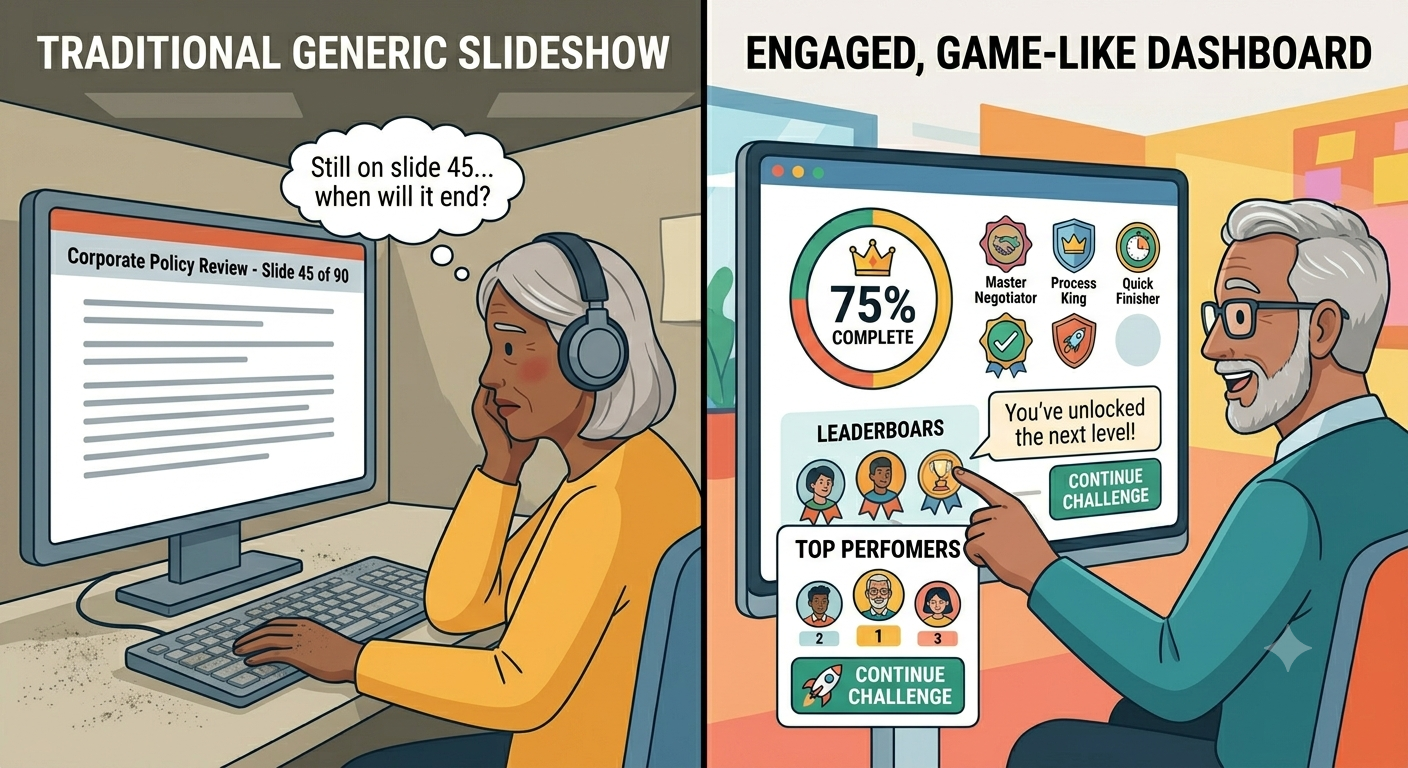
Compliance training has a reputation problem. Ask almost any employee what comes to mind when they hear "mandatory training module," and the answer is rarely enthusiasm. It's usually a sigh, a tab opened in the background while they do something else, and a quiz clicked through as fast as possible just to get the certificate.
The content isn't the problem, most compliance material covers genuinely important things: safety, ethics, data privacy, workplace conduct. The delivery is the problem. Static slides, monotone narration, and a final quiz don't reflect how adults actually learn or stay motivated. That's where gamification comes in, and it's why more L&D teams are rethinking how compliance training gets built in the first place.
What Gamification in Corporate Training Actually Means
Gamification isn't about turning serious training into a video game. It's about borrowing the mechanics that make games engaging- progress, feedback, challenge, reward, and applying them to real learning content.
In practice, this looks like:
- Points and progress bars that show employees how far they've come, not just whether they passed or failed
- Levels or tiers that unlock more advanced or specialized content as employees demonstrate mastery
- Badges or certifications that recognize specific skills, not just course completion
- Leaderboards (used carefully) that introduce light, optional competition across teams
- Branching scenarios where a wrong choice has a visible, immediate consequence — much closer to a real workplace decision than a multiple-choice quiz
- Microsimulations that let employees practice a skill in a safe, risk-free environment before applying it on the job
None of this requires turning a workplace safety module into an arcade game. The goal is psychological, not cosmetic: give learners a sense of progress and agency, two things flat compliance content seldom provides.
Why Compliance Training Specifically Struggles Without It
Compliance training is uniquely vulnerable to disengagement for a few reasons:
- It's mandatory, not chosen. Motivation theory consistently shows that intrinsic motivation drops when a task feels imposed rather than selected. Gamification helps counteract this by giving employees a sense of control over how they engage, even when whether they engage isn't optional.
- It's often repetitive year over year. The same annual harassment or data-security training, recycled with minor updates, breeds completion fatigue. Branching scenarios and updated challenge formats keep returning learners from checking out.
- The stakes feel abstract until something goes wrong. A slide telling someone "don't click suspicious links" is forgettable. A simulation where they almost fall for a phishing email and see the consequence play out is not.
The Business Case: Engagement Isn't Just a Nice-to-Have
For L&D leaders justifying a redesign budget, the data side matters as much as the experience side. Organizations that move from static to gamified compliance training typically report:
- Higher completion rates, especially for optional refresher modules
- Better knowledge retention, since active decision-making (branching scenarios, simulations) embeds information more durably than passive reading
- Reduced time-to-competency for new hires going through onboarding compliance tracks
- Fewer real-world incidents are tied to the exact behaviors being trained (safety violations, data mishandling, policy breaches), since gamified scenarios mirror real decision points more closely than text-based modules
The ROI conversation shifts from "did people click through this training" to "did this training actually change behavior", which is the metric compliance training was always supposed to hit.
How to Introduce Gamification Without Overdoing It
A common mistake is gamifying for the sake of it, slapping a leaderboard on top of the same dry content and calling it done. A few principles keep gamification purposeful rather than gimmicky:
- Match the mechanic to the goal. Use branching scenarios for decision-heavy topics (ethics, safety) and progress tracking for knowledge-heavy topics (policy, regulation).
- Make competition optional. Leaderboards motivate some employees and demotivate others. Offer them as an opt-in layer, not a mandatory display.
- Keep feedback immediate. The core power of gamification is fast feedback loops, don't bury results behind a final score screen.
- Tie rewards to real recognition where possible. A badge that shows up on an internal profile or contributes to a real certification carries more weight than a generic "well done" screen.
- Pilot before a full rollout. Test a gamified module against the existing version with one team or department, and compare completion and retention data before scaling.
Where This Is Heading
Gamification is increasingly being paired with AI-powered adaptive learning systems that adjust difficulty, pacing, and scenario branches based on how an individual learner is performing in real time. Instead of every employee getting the same gamified module, the experience starts to personalize itself: someone who breezes through the basics moves into more advanced scenarios, while someone who struggles gets more reinforcement before advancing.
This convergence, gamification plus adaptive AI, is where corporate training is headed next, and it's a meaningful shift from the one-size-fits-all compliance module that's dominated L&D for the past decade.
Final Thought
Compliance training doesn't have to be the part of the job everyone dreads. With the right gamification strategy, built around real behavioral goals, not just cosmetic game elements, it can become training that employees actually engage with, retain, and apply. That's a better outcome for compliance teams, a better experience for employees, and ultimately a stronger, safer organization.
Looking to redesign your compliance training into something your team actually wants to complete? TheEduAssist builds custom gamified eLearning experiences, from branching scenarios to AI-adaptive modules, tailored to your industry and compliance requirements.